
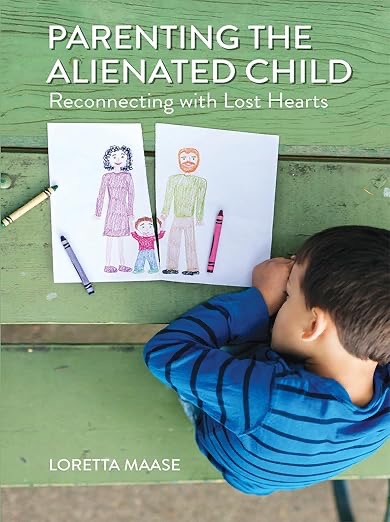
When a child rejects a parent, traditional parenting advice often fails—and well-intended responses can unintentionally make things worse.
Parenting the Alienated Child is a practical, developmentally grounded guide for parents navigating rejection, defiance, and fractured parent–child relationships in high-conflict family systems. Drawing on decades of clinical and forensic experience, Loretta Maase, MA, LPC, teaches parents how to respond with calm authority, emotional containment, and clarity—without arguing, pleading, or withdrawing.
This book is not about blame. It is about how to parent effectively when the relationship is under strain, how to distinguish normal developmental behavior from alienation dynamics, and how to position yourself for long-term repair—whether reconciliation happens now or later.
What people are saying about …
PARENTING THE ALIENATED CHILD
“This new book, Parenting the Alienated Child by Loretta Maase, occupies an important niche in parental alienation scholarship—what to do and what to say when trying to nurture an angry, rejecting child. The book’s foundation is an understanding of normal child and adolescent development; perhaps the most obvious example is distinguishing a typical teenager’s occasional defiance and disrespect from an alienated youngster’s persistent animosity and rejection. Parenting the Alienated Child has dozens of sample conversations regarding many topics, for example, ways to tactfully challenge a child’s false beliefs. This book will be helpful not just for parents themselves, but also for the counselors, therapists, and coaches who provide guidance for parents who are struggling with alienation in their families.”
William Bernet, M.D.
Professor Emeritus
Department of Psychiatry and Behavioral Sciences
Vanderbilt University School of Medicine
Nashville, Tennessee, USA
“Parenting your child while navigating alienation dynamics is akin to drinking from a firehose. Not only is the parent trapped in an emotional roller coaster of his or her own emotions, but the related enmeshed family dynamics of adultification, parentification, and infantilization that are often present in these cases makes it extremely difficult to parent the alienated child (or a child exposed to parental alienating behaviors).
It is not uncommon for parents who are caught in this maelstrom of family dynamics to have overwhelming feelings of frustration and despair: Damned if I do and damned if I don’t! Often, this frustration and despair results into the rejected parent lashing out at the child, or the favored parent, or against the “system,” on social media platforms and elsewhere. Such poor reaction is then confused and conflated with causation of the child’s rejection of the parent, creating further complexity.
Loretta Maase’s new book, Parenting the Alienated Child, is a shining beacon of hope. It not only offers parents helpful, practical suggestions on dealing with children’s rejection, hostility, defiance, and disrespect, but also provides valuable insight into the alienation dynamics. Ms. Maase’s book is a must read for every parent who is dealing with parental alienation, and every professional who is assisting or guiding such parent.”
Ashish Joshi
Attorney specializing in cases involving Family Violence and author of Litigating Parental Alienation: Evaluating and Presenting an Effective Case in Court (ABA, 2021).
Reunification therapy for parental alienation has been the subject of much controversy and misinformation. Loretta Maase is a therapist who is at the cutting edge of reunification therapy for families who have been afflicted by parental alienation. Her new book Parenting the Alienated Child: Reconnecting Lost Hearts is a major contribution toward shattering misinformation about reunification therapy. Throughout its pages, the reader can see the solid foundation of this therapy which is rooted in the science of family systems therapy. The reader will also see how a master therapist treats clients with sensitivity and realistic goals.
Reunification therapy for alienation is difficult work, and Maase prepares parents for the challenge both in the therapy and in helping them to understand the mindset and developmental stages of children who have been disconnected from their parents for many years. It is obvious from this book that Maase’s heart and soul is in the trenches with her clients as she feels their pain. This book will undoubtedly give the public, therapists and policymakers an enhanced understanding of the effectiveness, safety, and need for parental alienation reunification therapy.
Yaakov Aichenbaum
Parental alienation misinformation advocate
“This is a painful book to read as a parent who lost my children to alienation for over a year and, with Loretta’s help, not only won full custody but finally won back their hearts and minds. Reading it—especially chapter 21—was so hard and sad for me, a triggering reminder of where we were not so long ago with the kids being disrespectful and downright hateful to me. Chapter 22 was a terrifying glimpse into where we could have gone without your help.
Yet this book is also a roadmap of hope, filled with practical, applicable, “tried and true” wisdom for the alienation journey and beyond. You have so much wisdom and have surprised me with your insights again and again—so practical, doable, and compassionate. The book is amazing and clear, and you perfectly embody the “nurturing authoritative” parent as you present loving understanding alongside cold hard (helpful) truths. Wow!!!!!!
Parenting is intensely difficult in the most normal of situations, but parenting after being alienated takes extra patience, sensitivity, guidance and sometimes superhuman strength. I’m deeply saddened for any parents still experiencing this and for all the children suffering. Loretta and her book are literally a godsend and are sure to give answers and direction to anyone needing support in this often misunderstood area. May God bring peace and reunification to all his children soon.”
Love and infinite gratitude, Rina
“I wish I would have had this book ten years ago. After a decade of dealing with my children being alienated and seeing the emotional and psychological toll it took on them with very little understanding in the beginning of what was happening Loretta’s book would have been invaluable. As I read it, I felt as though the behavior describing, both the alienator, myself, and my children during the process was taken directly from our lives. Having no idea what was happening much less how to respond to it at the time left me with a feeling of hopelessness and constant loss. Watching your children be emotionally and psychologically abused with no idea how to stop it and the family court system only making it worse is something I would not wish on my worst enemy. The advice and techniques for responding to alienated children are invaluable to anyone going through this hell.”
Scott Sherrill
“As an alienated parent, I’ve often been told I focus too much on the alienation. But when your child is slowly turned against you through secret, emotional abuse, how could you not focus on it? If your child were being physically beaten every night, no one would ask you to ‘move on’—but when the abuse is emotional, suddenly it’s dismissed or misunderstood.
This book helped me see the importance of knowing what’s ‘normal’—so I can better understand, document, and share what’s not. It helped me realize that while not everything is alienation, recognizing what is (and what isn’t) is critical, especially when communicating with professionals and the courts.
This message is too important to be brushed off as just another ‘Karen complaint.’ We don’t get many chances to be heard—so we have to make it count.”
— An Alienated Mother
“There is no one-size-fits-all solution for alienated parents, but one common challenge we face is having to tread carefully when parenting an alienated child. Loretta Maase captures the feelings of many alienated parents and highlights what we often think but struggle to understand. How do I love a child that is just so awful to me? As a mother of an alienated son, I always wondered if he’d ever let me nurture and love him like before. I’ll never forget when he last described me as caring in front of the therapist. I knew deep down his authentic self was there, but would I always have to walk on eggshells? No one shows you how to pick up where you left off.
Parenting the Alienated Child: Reconnecting with Lost Hearts provides insightful lessons on reassessing your alienated child’s cryptic cues, while remaining hopeful after letting go. Thank you, Loretta, for your incredible work and unwavering advocacy.”
Claudia Ovalles